The Truth About "Natural" Mosquito Sprays (And What to Do Instead)
Key Takeaways:
•"Natural" mosquito sprays often use pyrethrins, which are highly toxic to bees, butterflies, and fireflies.
• Many companies substitute natural ingredients with synthetic pyrethroids, which persist in the environment for weeks.
• A 2025 Xerces Society study found 100% of sprayed yards had lethal pesticide levels for pollinators.
• The safest mosquito control method is using Bti (Mosquito Dunks) in a DIY "Bucket of Doom" trap.
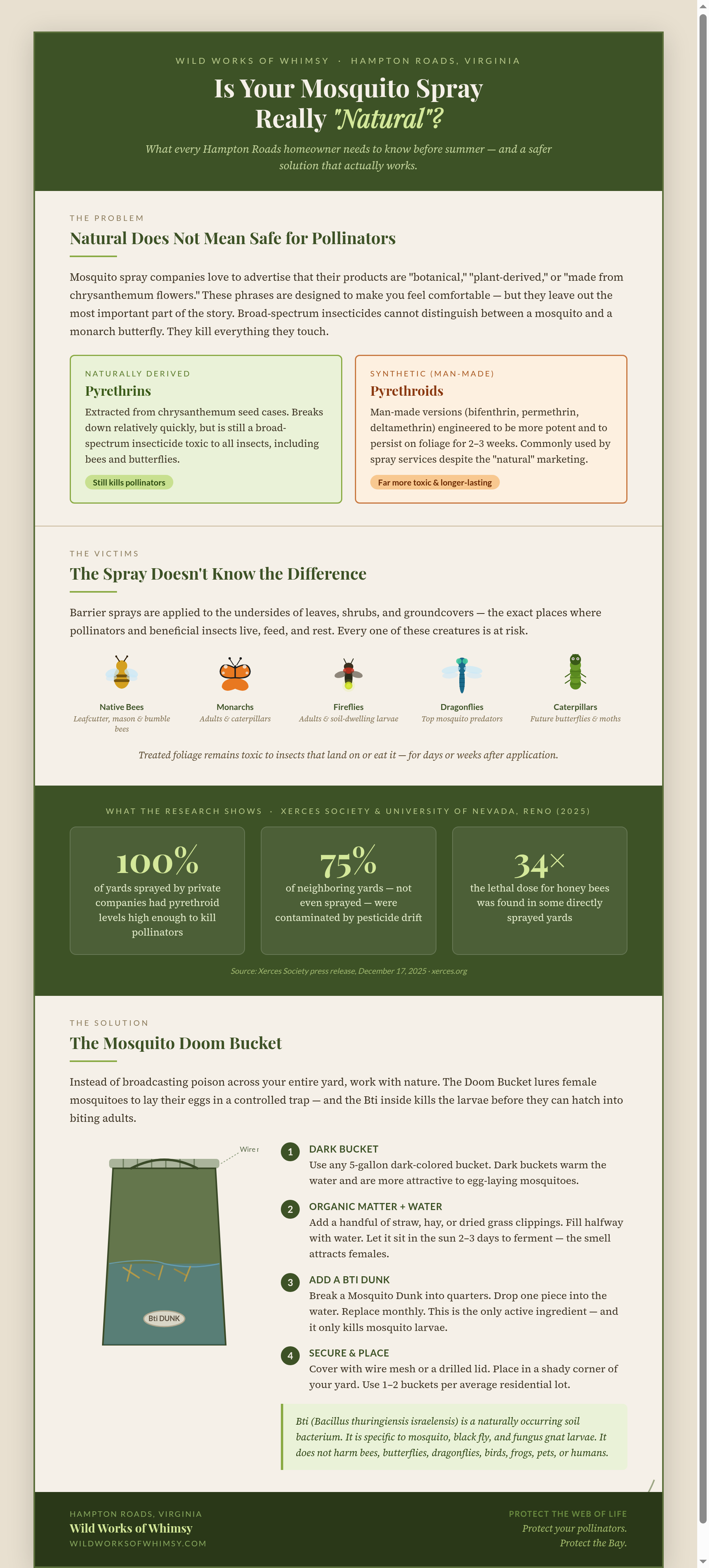
As the weather warms up here in Hampton Roads, Virginia, the mailboxes start filling up with postcards from mosquito control companies. Many of these companies advertise "natural," "botanical," or "eco-friendly" barrier sprays, promising to make your yard safe for your family and pets while protecting pollinators.
As a landscape designer and horticulturist who spends every day working to build healthy, resilient ecosystems, I need to be blunt: these claims are misleading, and in many cases, they are outright false.
If you are trying to create a pollinator-friendly yard, hiring a mosquito spraying service is one of the most destructive things you can do. Here is the truth about what is in those sprays, how they impact our local environment, and the safe, effective alternatives you can use instead.
Are Natural Mosquito Sprays Safe for Bees? The Pyrethrin Loophole
When a mosquito control company claims their product is "natural" or "derived from chrysanthemum flowers," they are usually referring to pyrethrins — naturally occurring compounds extracted from the seed cases of chrysanthemums.
However, "natural" does not mean "safe for all insects." Pyrethrins are broad-spectrum insecticides. They attack the nervous systems of insects indiscriminately. A pyrethrin spray cannot tell the difference between a mosquito, a monarch butterfly, a native leafcutter bee, or a firefly.
To make matters worse, many companies quietly substitute natural pyrethrins with synthetic pyrethroids (such as bifenthrin or permethrin). These man-made chemicals are designed to be more toxic and to persist in the environment for weeks. They are applied to the undersides of leaves, shrubs, and groundcovers — the exact places where butterflies roost, caterpillars feed, and fireflies hide during the day.
The Devastating Impact on Pollinators and Predators
A 2025 study by the Xerces Society and the University of Nevada, Reno found that 100% of yards sprayed by private mosquito control companies contained pyrethroid levels high enough to kill bees and other beneficial insects — and 75% of neighboring yards that were not sprayed were also contaminated by drift.
By spraying for mosquitoes, you are not just killing the pests; you are killing the predators that naturally keep mosquito populations in check. Dragonflies and damselflies are voracious mosquito hunters, both in their aquatic larval stage and as flying adults. When you eliminate these predators, you disrupt the food web, often leading to a worse mosquito problem in the long run.
Furthermore, pyrethroids are highly toxic to aquatic life. In our region, where runoff eventually makes its way into the Lynnhaven River and the Chesapeake Bay, widespread use of these chemicals poses a significant threat to our local waterways.
A Safe Alternative: How the Mosquito Bucket of Doom Works
You do not have to choose between being eaten alive and poisoning your local ecosystem. The most effective, scientifically backed method for controlling mosquitoes is targeting them before they hatch.
The Bucket of Doom uses a naturally occurring soil bacterium called Bti (Bacillus thuringiensis subspecies israelensis). Bti is highly specific: it only kills the larvae of mosquitoes, black flies, and fungus gnats. It is completely harmless to bees, butterflies, birds, frogs, pets, and humans.
By filling a bucket with water and organic matter (like straw or grass clippings), you create a stagnant, carbon-dioxide-rich environment that female mosquitoes find irresistible. They lay their eggs in the bucket, the eggs hatch into larvae, and the larvae eat the Bti and die before they can become biting adults.
We sell ready-to-go Mosquito Doom Buckets at Southern Branch Nursery — stop by to pick one up!
DIY Instructions
If you prefer to make your own, it's simple and inexpensive:
Get a bucket — a 5-gallon bucket or any dark-colored container works well.
Add organic matter — a handful of straw, hay, or dried grass clippings.
Add water — fill about halfway. Let it sit in the sun for a few days to ferment; this creates the smell that attracts female mosquitoes.
Add the Bti — break a Mosquito Dunk (available at most hardware stores) into quarters and drop one piece into the water.
Secure the trap — place chicken wire or a lid with large holes over the top to prevent pets or wildlife from drinking the water. A sturdy stick leaning over the rim also gives small animals an escape route.
Placement and maintenance — set the bucket in a shady, quiet corner of your yard. Top off the water as it evaporates, and replace the Bti dunk every 30 days.
Protect the Web of Life
As homeowners, we have incredible power over the patches of earth we steward. By rejecting toxic barrier sprays and embracing targeted, ecological solutions like Bti, we can enjoy our outdoor spaces while ensuring that our native bees, butterflies, and fireflies continue to thrive.
Want to learn more? Here are some excellent resources:
🎙️ Podcast:"The Harmful Consequences of Mosquito Sprays" — In Defense of Plants, Ep. 563 (with Dr. Aaron Anderson of the Xerces Society) https://www.indefenseofplants.com/podcast/2026/1/27/ep-563-the-harmful-consequences-of-mosquito-sprays
🎙️ Podcast:"Best Practices Around Mosquitoes" — A Way to Garden with Margaret Roach (featuring Nancy Lawson, The Humane Gardener ) https://awaytogarden.com/best-practices-around-mosquitos-with-nancy-lawson/
🎙️ Podcast:"Plastic Bands, Pesticides, and Deadly Drift" — Xerces Society Bug Banter (discusses the actual drift study ) https://www.xerces.org/bug-banter/plastic-bands-pesticides-and-deadly-drift-study-on-mosquito-spray
📖 Article:"Are mosquito sprays made from chrysanthemum flowers safe for bees and butterflies?" — Xerces Society https://www.xerces.org/blog/8-common-pesticide-questions-answered
📖 Article:"In the Shadows of Butterflies" — The Humane Gardener (Nancy Lawson ) https://www.humanegardener.com/in-the-shadows-of-butterflies/